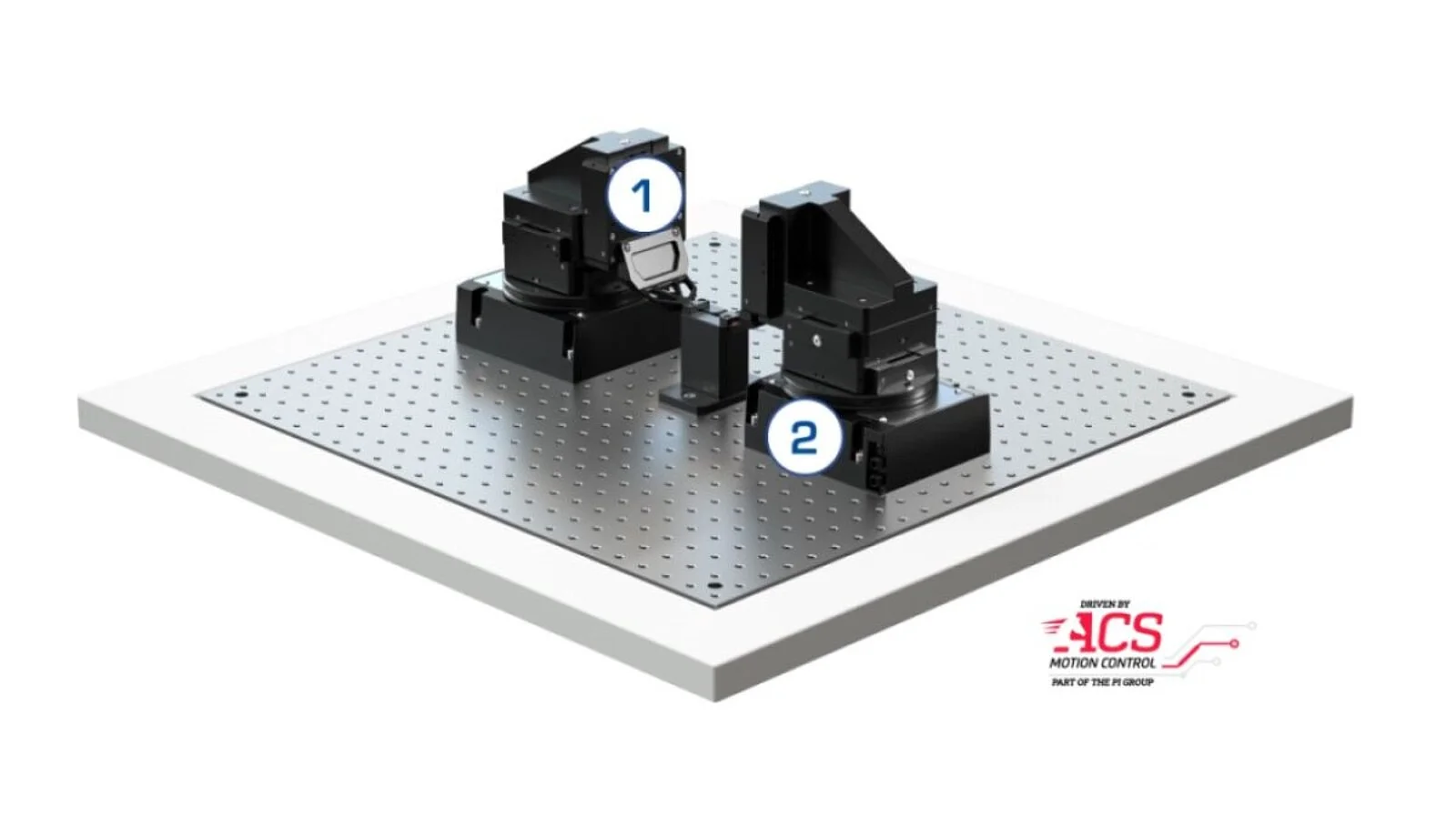
Silicon photonics plays a crucial role in the advancement of cutting-edge technologies such as quantum computing, nanosatellites, light detection and ranging (LIDAR), or optical logic, as well as in improving data processing, storage, and transmission. These technologies place many challenges on test and packaging processes, especially when it comes to the alignment of fiber optic devices in high volume production environments with high cleanliness requirements.
PI offers advanced motion solutions for fast, 24/7, automated operation based on different motor, guiding and sensor technologies. Complemented by unique proprietary alignment algorithms for the parallel optimization of any figure-of-merit, the solutions can increase throughput by a factor of more than 100.
Key Features of the Motion Solution
- Production class automated photonics alignment
-
Increase in throughput by a factor of 100
-
Reliable performance during 24/7 operation
-
Suitable for extremely clean application areas
-
Lowest cost of ownership
-
Optimization of any figure-of-merit

XYZ Axis – Fiber-to-Fiber or Fiber-to-Waveguide Alignments
- Friction- and maintenance-free air-bearing design for 24/7 high duty cycle applications
- Voice coil direct drive motor for smooth operation, high dynamics and fast step-and-settle
- Integrated linear encoders for accurate positioning
- Innovative and compact XYZ design for space-saving integration
- Integrated Z-axis counterbalance enables vertical operation with minimal impact on stage's form factor

θZ Axis – Precise Rotational Positioning of Photonic Devices
- Highly accurate and repeatable 360° rotation without backlash
- Direct-drive motor technology enables smooth and precise operation without cogging
- Brushless torque motor for high dynamics
- High-precision absolute or incremental encoder options
- Low-profile design for space-saving integration

User-Friendly and Flexible Automation Control
- High-performance industrial controller with onboard ACS-based alignment algorithms
- Proprietary firmware provides fast area-scanning algorithms for first light detection, as well as gradient and centroid algorithms for peak coupling
- Software support for common operating systems, as well as for many programming languages including MATLAB , Python, C# and NI LabVIEW
System in Motion