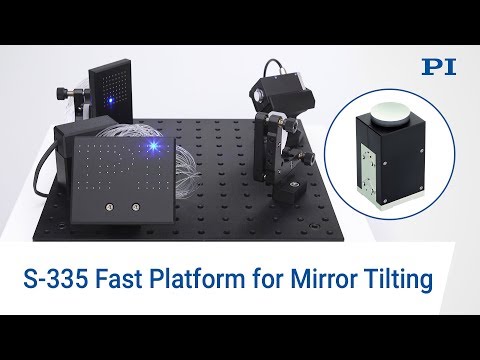
Piezo flexure mirror systems' high rigidity enables them to have great dynamics and outstanding position stability. The small, portable devices are widely employed for laser steering and beam deflection in laser processing. With a common fixed pivot point and no change in polarization direction, their parallel-kinematic architecture produces comparable performance in tip and tilt axes.
Frictionless flexure guides and high-speed solid-state piezoelectric motors are the foundation of PI's ultra-fast laser beam steering mirror platforms and dither scanners. Pitch and roll motion are combined into one device with just one moving mirror or optic in these small 2-axis scan mirrors. They can be employed in static and highly dynamic operations (such as scanning, tracking, improving image resolution, drift/vibration cancelling), and they are faster than galvo-scanners and voice-coil beam steering systems (both offered by PI).
Scanners, precision optical dithering, free-space optical communication (FSO), image stabilization, laser welding, semiconductor test & manufacturing, laser beam stabilization / steering, astronomy, two photon polymerization, and medical applications are just a few of the uses for voice-coil / piezo-actuated mirror mounts.
The parallel kinematics design of the PI steerable mirrors has several benefits, including coplanar multiaxis motion, sub-millisecond response times, excellent resolution (up to nanoradian range), and extensive travel lengths (up to 3 degrees deflection). A single platform/mirror is used for all axes in PI's parallel-kinematic multi-axis steering mirrors. There is only one common pivot point, similar to a gimbal mount, and there is no polarization rotation, which is a crucial characteristic for many precision optical applications.