Six degrees of freedom of motion are offered by hexapods in the smallest possible form. PI hexapods meet industrial standards by combining absolute measuring sensors, software, and motion controllers that make even the most complex motion profiles simple to command. Each drive type can be combined to satisfy the requirements of a specific application.
The widest range of standard hexapods includes equipment for industrial production operations where hexapods position heavy loads with sub-micrometer accuracy, as well as tiny versions for sample positioning in beamline studies and high-resolution dynamic positioners for fiber alignment.
Motion hexapods offer more dynamic motion and are made to precisely follow pre-determined trajectories, such as in camera test stands.
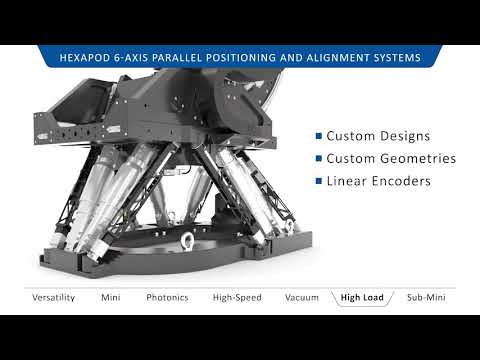
Hexapods, or Stewart Platforms, are 6-axis positioning stages that are based on parallel kinematics. A parallel 6-axis actuator system (XYZ, Pitch, Roll, Yaw) is fitted between a top and bottom platform to construct a hexapod positioning system. In comparison to serial kinematics stages, PI's parallel kinematics (PKM) multi-axis precision positioning systems have various benefits, such as decreased inertia, enhanced dynamics, a smaller package size, and higher stiffness. All PI high-performance hexapod multi-axis motion controllers feature a user-programmable pivot point, which offers significant advantages, particularly in applications for aligning lenses, optics, and fiber optic components.
Application fields
Industry and research. For micromanufacturing, medical technology, tool inspection.
For tool inspection, life science, micromanufacturing, micromanipulation, industrial alignment systems. For assembly, alignment, and inspection of optical components.
For astronomy, optics positioning, aerospace.
test systems, e.g., for image stabilization in cameras or mobile devices. Industry and research. For astronomy, aerospace.
The simulation software simulates the limits of the workspace and load capacity of a hexapod. Therefore, even before making a purchase, you can check whether a particular hexapod model can handle the loads, forces, and torques occurring in an application. For this purpose, the simulation tool takes into account the position and motion of the hexapod as well as the pivot point and several reference coordinate systems.